


Filling a series with complex numbers is a sophisticated task that demands a nuanced understanding of both the properties of complex numbers and the specific requirements of the filling process. As a leading supplier of Filling Series, we have extensive experience in dealing with various filling scenarios, from liquid bottle filling to more complex multi - function machine operations. In this blog, we will delve into the steps and considerations for filling a series with complex numbers, bridging the gap between mathematical concepts and real - world industrial applications.
Understanding Complex Numbers
Complex numbers are of the form (z = a+bi), where (a) and (b) are real numbers, and (i=\sqrt{- 1}). The real part (a) and the imaginary part (b) have unique roles in defining the behavior and properties of the complex number. When it comes to filling a series with complex numbers, we first need to understand the nature of the series. A series could be arithmetic, geometric, or follow a more custom - defined rule.

For an arithmetic series of complex numbers, the general form is (z_n=z_1+(n - 1)d), where (z_1) is the first term and (d) is the common difference. For example, if (z_1 = 2 + 3i) and (d=1 + 2i), then (z_2=z_1 + d=(2 + 3i)+(1 + 2i)=3+5i), (z_3=z_2 + d=(3 + 5i)+(1 + 2i)=4 + 7i), and so on.
In a geometric series of complex numbers, the general form is (z_n=z_1r^{n - 1}), where (z_1) is the first term and (r) is the common ratio. Suppose (z_1 = 1 + i) and (r = 2i), then (z_2=z_1r=(1 + i)\times(2i)=2i+2i^2=-2 + 2i), (z_3=z_2r=(-2 + 2i)\times(2i)=-4i+4i^2=-4 - 4i).
Defining the Series Requirements
Before filling a series with complex numbers, we must clearly define the requirements. This includes determining the length of the series (n), the starting point (z_1), and the rule governing the progression of the series. In industrial applications, these requirements are often analogous to setting the parameters for a filling machine. For instance, when using a Liquid Bottle Filling Machine, we need to define how many bottles will be filled (equivalent to the length of the series), the initial state of the filling process (equivalent to (z_1)), and the pattern of filling (equivalent to the rule of the series).
If the series is part of a control algorithm for a filling machine, the complex numbers might represent different states of the machine, such as flow rate and pressure. Each state is a combination of real and imaginary components that together describe a complex operating condition. By carefully defining the series, we can ensure that the machine operates optimally over the entire production cycle.
Calculating and Filling the Series
Once the requirements are defined, we can start calculating the values of the series. For simple arithmetic or geometric series, the calculations are relatively straightforward, as shown in the previous examples. However, for more complex series, we may need to use iterative methods or mathematical models.
Let's consider a custom - defined series where (z_{n+1}=z_n^2+ c), where (c) is a fixed complex number. This is similar to the Mandelbrot set calculation. Suppose (z_1 = 0) and (c = 0.2+0.3i). Then (z_2=z_1^2 + c=0+(0.2 + 0.3i)=0.2+0.3i), (z_3=z_2^2 + c=(0.2 + 0.3i)^2+(0.2 + 0.3i)). Expanding ((0.2 + 0.3i)^2=0.04+0.12i + 0.09i^2=-0.05+0.12i). So (z_3=-0.05+0.12i+0.2 + 0.3i=0.15+0.42i).
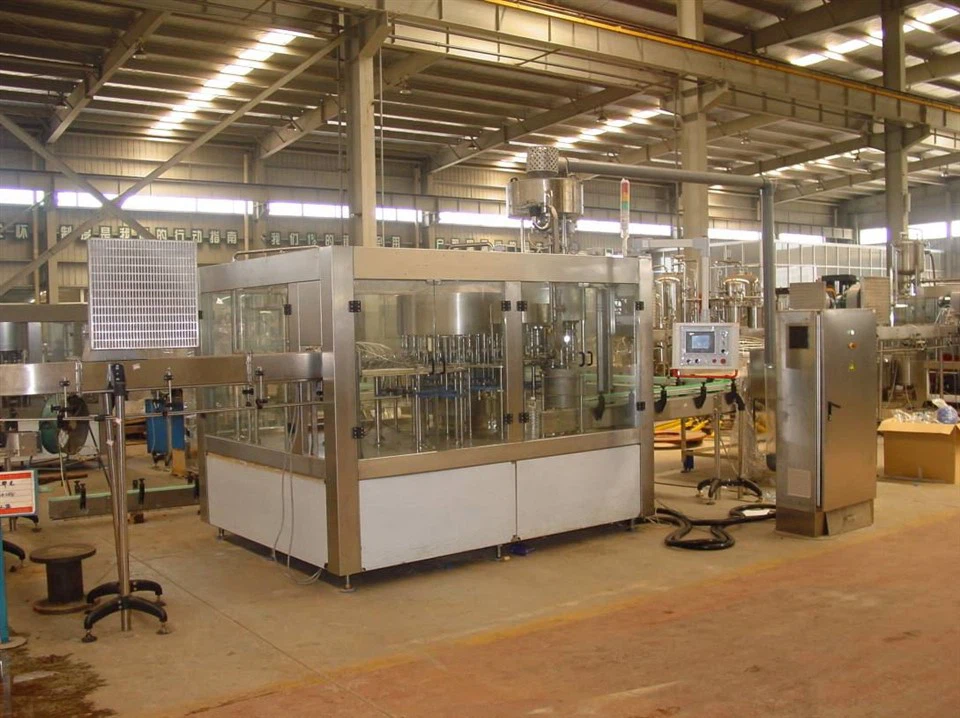
In the context of our Filling Series products, we can think of these calculations as programming the machine to follow a specific filling pattern. For a Washing Filling Capping Machine XLWF16 - 16 - 5, the complex number series could represent the sequence of operations and the associated parameters at each step.
Error Handling and Quality Control
When filling a series with complex numbers, it is crucial to implement error handling and quality control mechanisms. In the mathematical sense, errors can occur due to numerical approximations or incorrect application of the series rule. In industrial applications, errors can lead to product defects or machine malfunctions.
For example, if the calculated complex number values for a filling machine's control algorithm are out of the acceptable range, it could result in over - filling or under - filling of bottles. To prevent this, we can set up checks at each step of the series calculation. If a calculated value exceeds a predefined limit, the machine can be programmed to pause and alert the operator.
In addition to error handling, quality control is essential to ensure the consistency of the series. In our Filling Series products, we use advanced sensors and monitoring systems to ensure that each filling operation meets the required standards. For a Fully Automatic Soda Liquid Filling Machine, we monitor factors such as carbonation level, filling volume, and pressure to ensure that every bottle of soda meets the quality requirements.
Applications in Filling Series Products
The concept of filling a series with complex numbers has numerous applications in our Filling Series products. In liquid bottle filling machines, complex numbers can be used to model the flow dynamics of the liquid. The real part of the complex number could represent the volume of liquid flowing per unit time, while the imaginary part could represent the turbulence or pressure variations in the flow.
In multi - function machines like the Washing Filling Capping Machine XLWF16 - 16 - 5, complex number series can be used to coordinate the different operations. Each step of the washing, filling, and capping process can be assigned a complex number, and the series progression can ensure that the operations are carried out in the correct sequence and with the appropriate parameters.
For fully automatic soda liquid filling machines, complex numbers can help in controlling the carbonation process. The complex number series can represent the changing levels of carbon dioxide in the liquid over time, allowing for precise control of the carbonation process.
Conclusion
Filling a series with complex numbers is a multi - faceted process that combines mathematical knowledge with practical industrial applications. As a Filling Series supplier, we understand the importance of accurate calculations and reliable operations. By leveraging the power of complex numbers, we can optimize the performance of our filling machines and ensure high - quality products for our customers.
If you are interested in our Filling Series products or have any questions about filling a series with complex numbers in the context of industrial applications, we encourage you to contact us for a detailed discussion. Our team of experts is ready to assist you in finding the best solutions for your filling needs.
References
- "Complex Analysis" by Lars V. Ahlfors
- "Advanced Engineering Mathematics" by Erwin Kreyszig
- Technical manuals of our Filling Series products


